


Category: News
Rose
By Rachel Berger
Sometimes you just fall in love for no real reason at all. Or at least not a reason that makes any sense when you are trying to explain using proper, sophisticated words.
That is what happened to me at Avrankou, St. Camille’s first mental health treatment center in Benin.
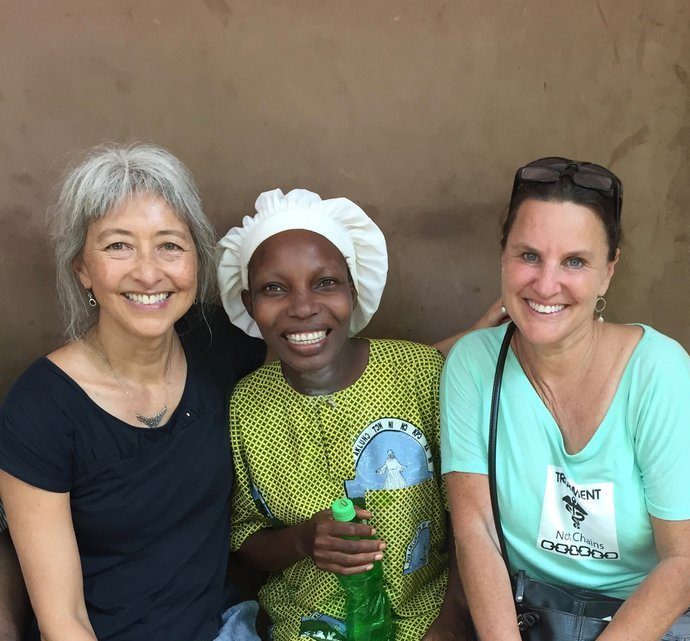
It was love at first sight when I saw Rose, rocking her bad ass white chef hat. It also doesn’t hurt that Rose is singing and dancing to welcome us. In addition, she has a smile that would force you to wear sunglasses in hell and her cheekbones are the highest you have ever seen.
So I am more than delighted when Rose begins to follow us as we tour Avrankou, which, as the very serious director would like you to know, was established in 2004 and has treated more that 15,600 inpatients and outpatients.
It is Rose who runs interference for me when I stop to video the women cooking something boiling in two large pots and when I run around to the other side of the wall to see how they feed wood into the stove from a small hole in the wall.
Again, it is Rose who gets a broom to clean a cement step which I suggest we sit on. When we eventually walk across the road to eat, Rose holds my hand. I tell Rose how my grandmother and one of my closest friends are both named Rose, which Rose of Avrankou says makes us sisters.
Then as we (the visiting guests) eat in a large clean white room with a fan and below a photo of Gregoire with one of those flyover Popes (you know the one’s between Vatican II and the people’s pope, Francis), Rose waits outside in the atrium. (For the record, this wasn’t my party, or I would have had her eat fish and chicken and rice with us.)
When we finish lunch, I plop down on a wooden bench next to Rose as the others discuss important affairs.
The truth is, Rose and I are blabbing about nothing so much I never ask her all my journalist questions; how did you get here, what was happening in your head, how is your life now.
We share handfuls of baby powder and when Rose gets so much on her face that she looks like a zombie, we laugh and I brush it off and give her a big hug just because she makes me so happy.
And then she says I love you and I say I love you back and I really mean it.
I hope somehow, somewhere we will meet again because I really did fall for that girl.
Jane’s Journey from Nigeria to St. Camille
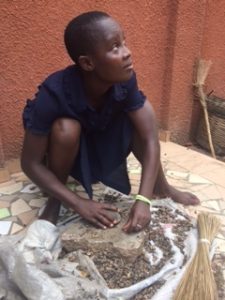
Jane, originally from Nigeria, brought four children into this world but unfortunately had to see two of them leave it.
Jane came to the Calavi mental health center about 8 months ago. She says the voices in her head were tormenting her and shouting at her without rest. She felt that her husband was working with a witch to harm her and he was plotting to cut her head off.
She is not clear when the voices inside her head began, but she says it was long before her second and third child died.
She mentions it was a priest who found her in the street, weak, dirty and confused and brought her to the “Oasis of Love” at Calavi in Benin. She has not seen her 10 year old for one year since she arrived at the center and fears that if they saw her now they would reject her.
Jane says she’s found some comfort at Calavi cooking and breaking open ground nuts with her friend and fellow patient, Victorienne.
Jane gets two injections to control her delusions twice a month and she takes pills on a daily basis.
She says she still hears voices sometimes but they don’t come as often and they are not as strong.
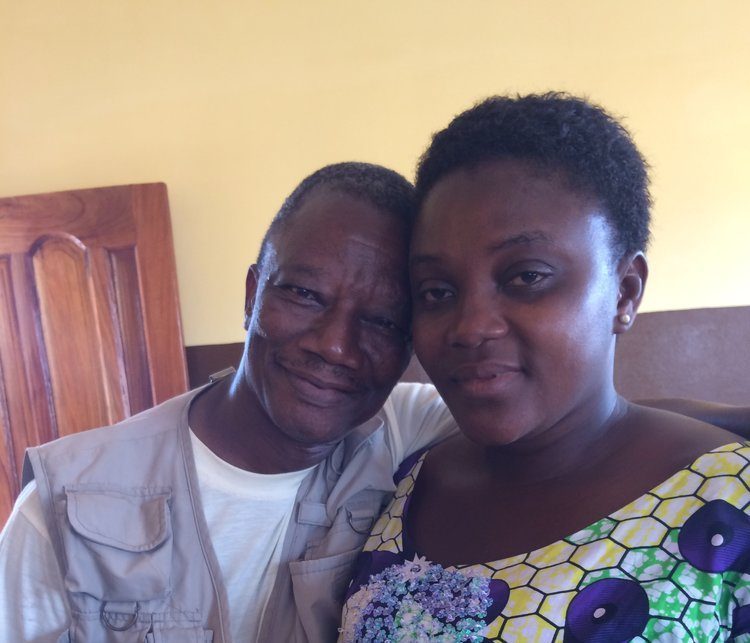
Fabienne’s Trauma from Chains in a Camp
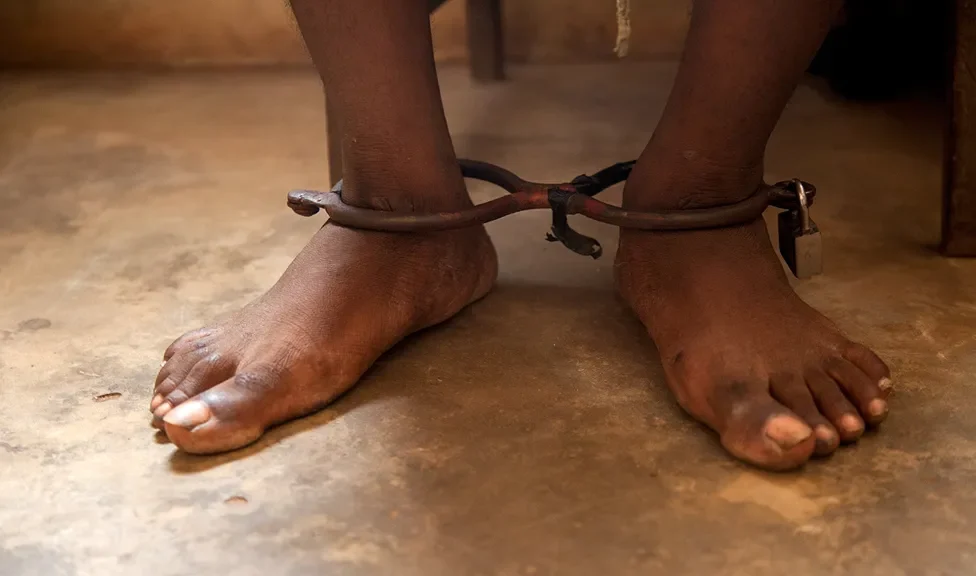
Treatment Not Chains takes its name from the inhumane practice of chaining mentally ill people to trees in “prayer” centers. On Monday, we got a firsthand glimpse into how this practice deeply affects people, even those who spend only a few months under these conditions, a short time compared to those who live there for years. The new treatment center in Togo opened its doors to patients on Monday, and one of them, Fabienne (whose name has been changed for privacy purposes) had been sent to a prayer center 8 years ago, shortly after her bipolar disorder began. Although she came to the center fully composed and beautifully dressed, Fabienne began crying and shouting during her intake interview.
“Every morning they would take me to that mango tree and put a chain around my ankle and just leave me there. They chained me up! Every day they hit me and mistreated me and it makes me crazy when I think about it. Even when I needed to go to the bathroom, they would just bring me a pot and I would have to do it right there in front of everyone. Can you imagine? How can you take an educated person and have them go the bathroom in front of everyone like that? That is no way to cure a person. It hurts me when I think about how they treated me,” she said.
The anguish in her voice was so excruciating, tears started coming out of my eyes without my even realizing. Even Gregoire, who has seen many horrible things, was tearing up. When we talked with her father afterwards, it appeared that sending her to this prayer center had not been an agonizing decision or the result of any particularly strong belief, but simply one in a series of steps he had taken to try to address his daughter’s mental illness.
Fabienne went to eat lunch at the center and when I chatted with her afterwards, she told me that she lived nearby and would not be coming to live at the center because her case was not that serious. It was clear that she didn’t want to be identified as someone similar to some of the more visibly mentally ill people who would soon be filling the center. Soon after, something surprising happened. Gregoire convinced her to leave with us that afternoon to go to a treatment center in Benin where no one would know her and she could get some space from her problematic relationships at home. He told her that next year he would send her to school and she could study to be a nurse if she wished to. She and her father were both in agreement. We left for lunch and Gregoire told her to be there when we returned.
After lunch she had packed her bags but then changed her mind and said she needed more time to think about it (a reasonable reaction given that she had just met Gregoire and his three crazy white sidekicks a few hours earlier). Gregoire was not daunted. He took her back to her house to talk to her father. After a short time, she reemerged and got in the car. It was a 5+ hour ride back to Benin with Fabienne squeezed in the back seat between me and Rachel. During the drive, Gregoire had her call her priest and her sister so she wouldn’t feel disconnected and would get reassurance about her decision.
Fabienne was quiet during the drive but responded to questions and helped me recover a bit of my Mina, the language of southern Togo. Gregoire continued to talk to her about the training she would receive and how she would be able to help others. I was simultaneously impressed, moved and apprehensive about how this decision was playing out. We would certainly have expected a lot more information and discussion before packing someone up and taking them from their parent to an unseen facility in another country. But Gregoire was convinced that her relationship with her father would continue to impede her recovery and that it is best to seize the moment to make a change. He has 20 years of experience in this work, and this couldn’t be a more different culture so I resisted the impulse to even formulate an opinion about the whole thing.
Arriving close to midnight, Gregoire introduced Fabienne to a young woman who, like her, is well educated. She struggled with her mental illness for many years but was stabilized at the center and is now playing a large role in its operation. There were smiles and kisses; Fabienne was happy that she would get started on new meds that night. It looked promising.
We learned the next day that Fabienne was anxious and wanting to go home. She wasn’t just home sick but had a financial concern. Apparently someone was sending her father $12 a month to pay for her two medications. She was forgoing one of them so she could keep $5 each month for spending money. She was afraid that if this benefactor heard that she was in a free treatment center, he/she would stop sending the money. Gregoire assured her that she would have everything she needed, and he would give her the $5 a month, saying “aren’t you worth more than $5?”
The end of this story remains to be seen.

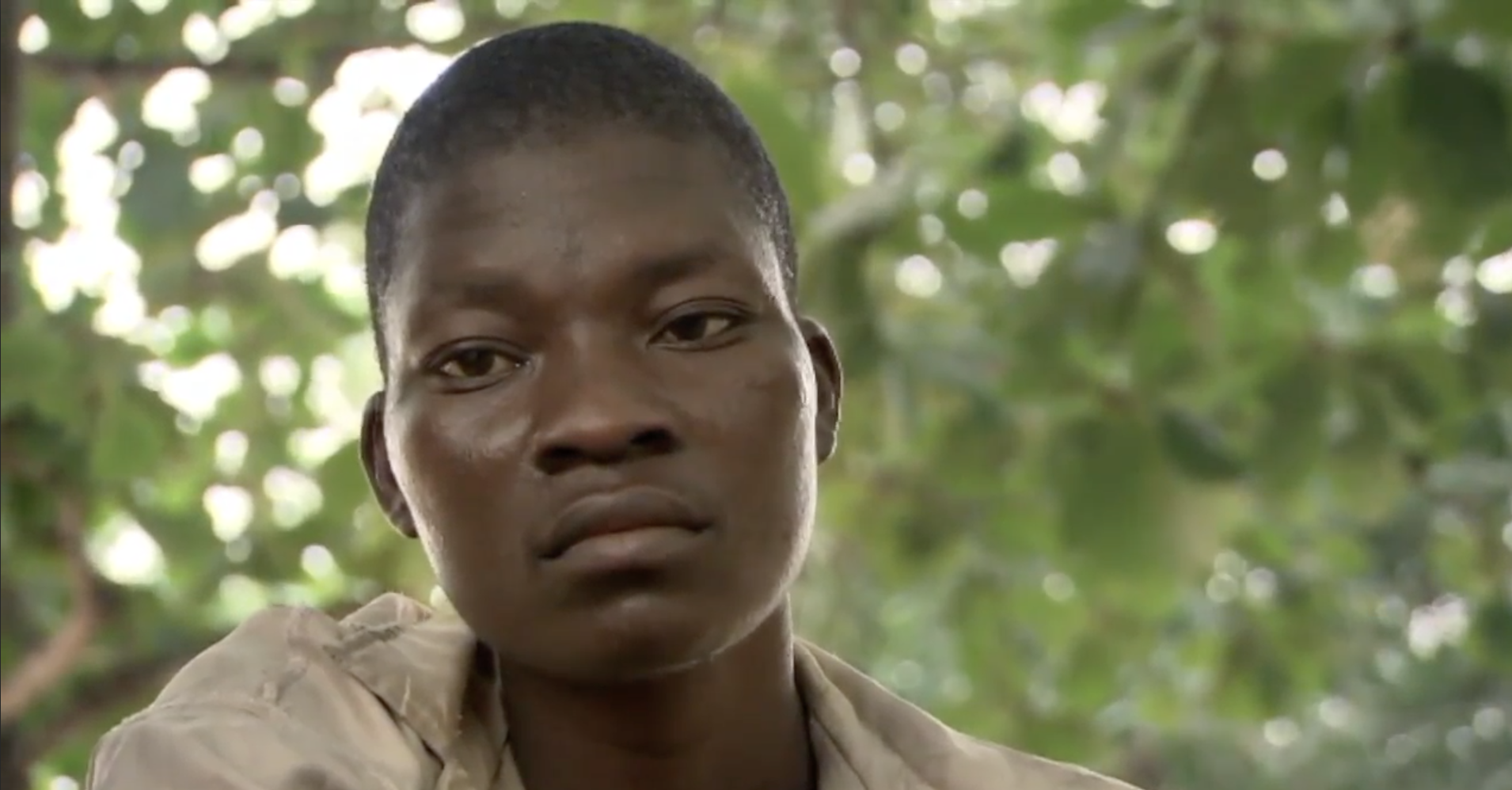
Documentary produced by Victoria Baux for Al Jazeera
Ms. Baux grew up in the Ivory Coast, and the second half of the film (minutes 20:00-46:00) follows the story of several people who were treated by St. Camille.