Contacts

92 Bowery St., NY 10013

+1 800 123 456 789

By James Grimm, MD In 2015 the New York Times published a video, “Praying for a Cure”. I have watched it many times, not believing the conditions under which these mentally ill individuals live. Such confinement would hinder any treatment and they sadly often face a lack of options. This was my introduction to the Association Saint Camille. Its founder and director, Gregoire Ahongbonon, provided some initial comfort to my dismay. His inspiration led to my first trip to Benin in January 2020. I was out of my professional comfort zone for the first time in years. A tour of Saint Camille’s various treatment settings helped relieved any anxieties as I was greeted by clients singing and dancing. Equally uplifting was Saint Camille’s policy to provide care to anyone regardless of their ability to pay. Such access gave hope for these individuals. I will return to Saint Camille as it offered a practice of psychiatry that is both necessary and fulfilling. There is no greater satisfaction than restoring someone’s dignity and allow them to achieve their potential.
News

Pauline, Future Dressmaker

By Estelle Agboton and Serena Clayton

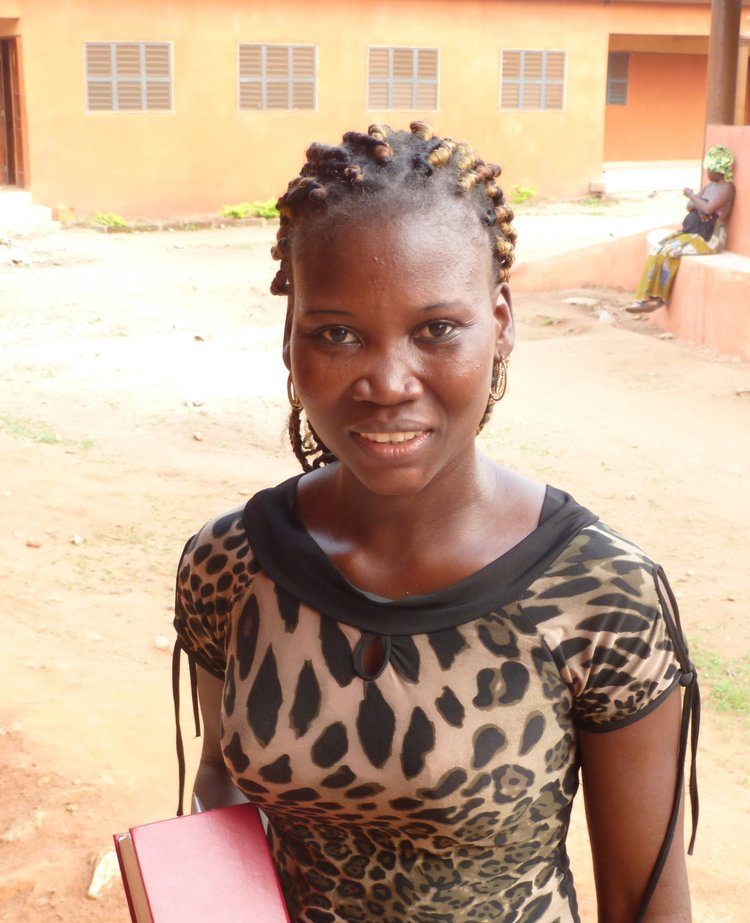
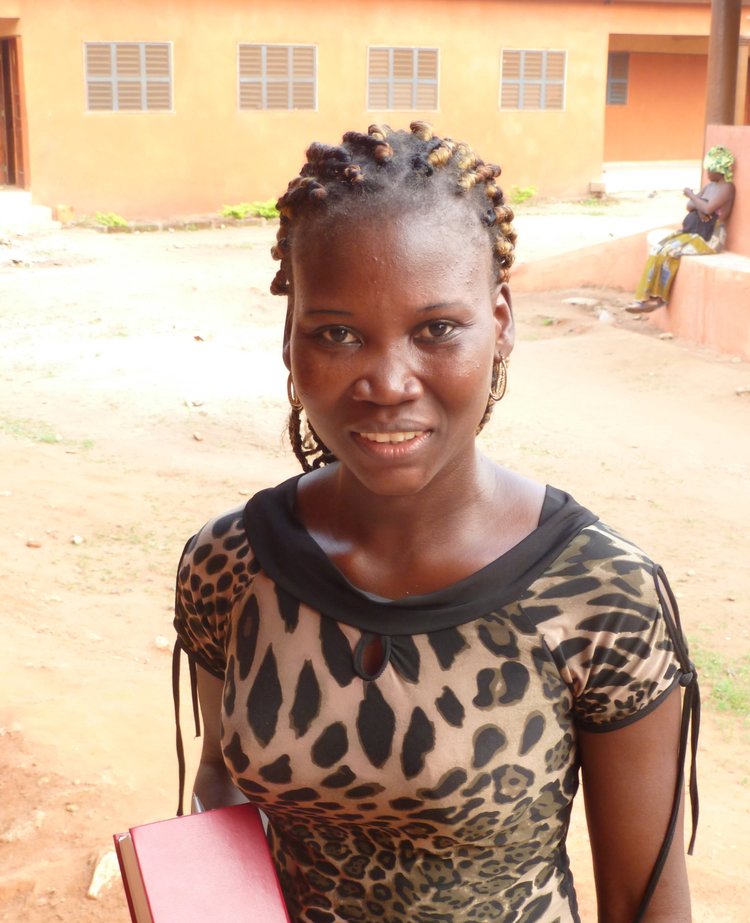
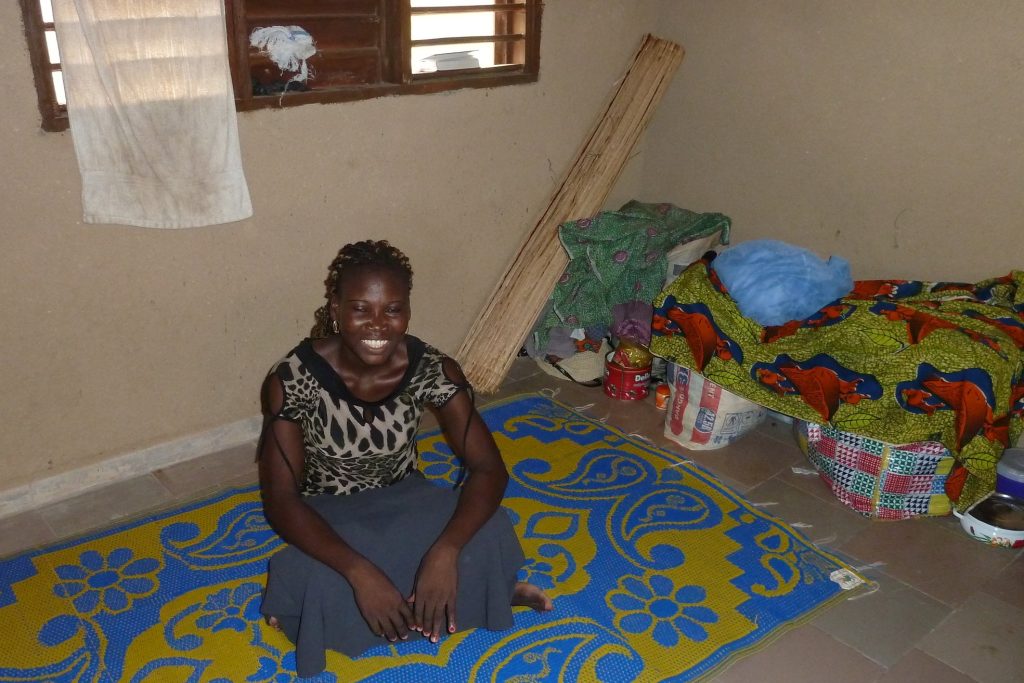
Pauline’s plan to become a great dressmaker was something she could never have imagined when she was being beaten to “cure” her delusions and uncontrollable behavior. Born in 1994 in a small city in the north of Benin, Pauline was well-loved by her parents and five siblings. But due to illness and financial hardship, she dropped out of school in third grade and was sent to work as a servant in a family home. After a few years, the family accused her of robbery and sent her to a religious leader to force her to confess which precipitated a mental breakdown. She refused to speak, heard voices and became aggressive. The family sent Pauline back to her parents who took her to evangelical churches and fetish worshipers where she drank herbal teas and was beaten by healers, none of which seemed to help. Pauline’s condition worsened over the next several years until 2015 when her family learned about the work of St. Camille. They took Pauline to St. Camille’s dispensary in her home town where she was evaluated and given medication. Within two weeks, she was markedly improved. She then agreed to enter St. Camille’s residential program in Djougou where she became part of a supportive therapeutic community. She has now graduated to the rehabilitation center at Calavi where she is learning sewing and her plan to become a great dressmaker is within reach.
By James Grimm, MD In 2015 the New York Times published a video, “Praying for a Cure”. I have watched it many times, not believing the conditions under which these mentally ill individuals live. Such confinement would hinder any treatment and they sadly often face a lack of options. This was my introduction to the Association Saint Camille. Its founder and director, Gregoire Ahongbonon, provided some initial comfort to my dismay. His inspiration led to my first trip to Benin in January 2020. I was out of my professional comfort zone for the first time in years. A tour of Saint Camille’s various treatment settings helped relieved any anxieties as I was greeted by clients singing and dancing. Equally uplifting was Saint Camille’s policy to provide care to anyone regardless of their ability to pay. Such access gave hope for these individuals. I will return to Saint Camille as it offered a practice of psychiatry that is both necessary and fulfilling. There is no greater satisfaction than restoring someone’s dignity and allow them to achieve their potential.

By Estelle Agboton and Serena Clayton

Pauline’s plan to become a great dressmaker was something she could never have imagined when she was being beaten to “cure” her delusions and uncontrollable behavior. Born in 1994 in a small city in the north of Benin, Pauline was well-loved by her parents and five siblings. But due to illness and financial hardship, she dropped out of school in third grade and was sent to work as a servant in a family home. After a few years, the family accused her of robbery and sent her to a religious leader to force her to confess which precipitated a mental breakdown. She refused to speak, heard voices and became aggressive. The family sent Pauline back to her parents who took her to evangelical churches and fetish worshipers where she drank herbal teas and was beaten by healers, none of which seemed to help. Pauline’s condition worsened over the next

By James Grimm, MD In 2015 the New York Times published a video, “Praying for a Cure”. I have watched it many times, not believing the conditions under which these mentally ill individuals live. Such confinement would hinder any treatment and they sadly often face a lack of options. This was my introduction to the Association Saint Camille. Its founder and director, Gregoire Ahongbonon, provided some initial comfort to my dismay. His inspiration led to my first trip to Benin in January 2020. I was out of my professional comfort zone for the first time in years. A tour of Saint Camille’s various treatment settings helped relieved any anxieties as I was greeted by clients singing and dancing. Equally uplifting was Saint Camille’s policy to provide care to anyone regardless of their ability to pay. Such access gave hope for these individuals. I will return to Saint Camille as it offered a practice of psychiatry that is both necessary and fulfilling. There is no greater satisfaction than restoring someone’s dignity and allow them to achieve their potential.

several years until 2015 when her family learned about the work of St. Camille. They took Pauline to St. Camille’s dispensary in her home town where she was evaluated and given medication. Within two weeks, she was markedly improved. She then agreed to enter St. Camille’s residential program in Djougou where she became part of a supportive therapeutic community. She has now graduated to the rehabilitation center at Calavi where she is learning sewing and her plan to become a great dressmaker is within reach.
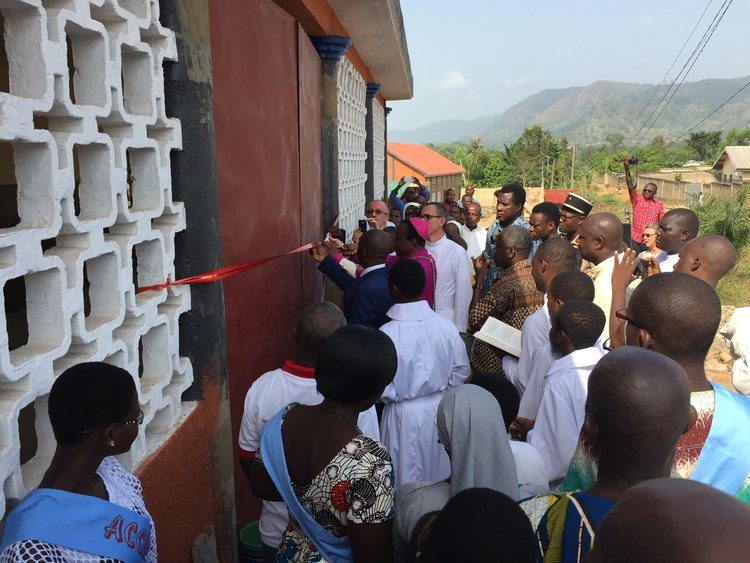
Grand opening of the first center in Togo, the Oasis of Love
News

Grand opening of the first center in Togo, the Oasis of Love

On the morning of the opening of the Oasis D’Amour (Oasis of Love) in Kpalime, Togo, patients from St. Camille’s centers Benin greeted visitors and dignitaries. The Oasis D’Amour is St. Camille’s first full treatment center in Togo, and patients from Benin had ridden in style in a large air conditioned bus to be part of the day of festivities.

Across the street, a band played; trombones ,trumpets, drums of all shapes and sizes played by musicians of varying ages and heights. Women in bright clothing danced with their children. As the band played, the contingent from Benin joined in and lined up to dance to the doors of the new center.

With St. Camille’s founder, Gregoire Ahongbonon and at the helm, prayers were read and acknowledgements were given before the great pink ribbon was cut.

Five days before the ribbon cutting, the center had opened for patients. On the first day, two people, a man and a woman of indeterminate ages, both dirty, emaciated in ripped clothing appeared at the door. Both appeared disoriented and unable to speak. They had been brought to the center by townspeople who knew they needed help. They were washed, fed, given beds and started on psychotropic medications.

Another woman, Fabienne, came with her father. Fabienne told in heartbreaking emotion, about how she had been chained to a tree in a prayer center all day, even forced to urinate in front of others. She cried with anger and humiliation as she told her story. Gregoire listened intently, took her hand and encouraged her to come to Benin where he promised she could work in the center and get training to become a nurse.

On the day the first patients arrived, the center had hardly been ready for the dignitaries. Men were hammering, sawing and making bricks. There were sinks to install, walls to be painted, and lights to be wired. The entire floor of the church still needed to be tiled. Some 200 men from across Togo and Benin yelled orders and instructions at each other in Fon, Kabiya, Mina, Ewe and French.

One of those men was 38 year old Ghislain. Ghislain had been a law student at the University of Abomey in Benin when things began going haywire for him. He started to hear voices and became paranoid. He tried to concentrate on his school work, but the voices became too loud and they drowned out his studies. He was only able to finish a year of school. His mother was frightened, and took Ghislain to the hospital. But still he faltered. She then learned of Gregoire’s treatment center and brought Ghislain. There he was given medication for his schizophrenia. At first, he said, he felt fatigued and listless, but after two weeks the voices in his head stopped. Ghislain began to work for Gregoire, first doing art projects with other patients. Now five years on, he is in charge of ordering and distributing supplies for the production of the Kpalime center. “It would be very difficult, if I had not met Gregoire, perhaps I would be in the streets, just walking,” he says. “I feel gratitude for what he has done for me, because now I can do many things, because I am well.” Ghislaine says in the future he would like to return to Benin, get married and have a family. He wants to return to his studies and help those who are in prison or mentally ill.

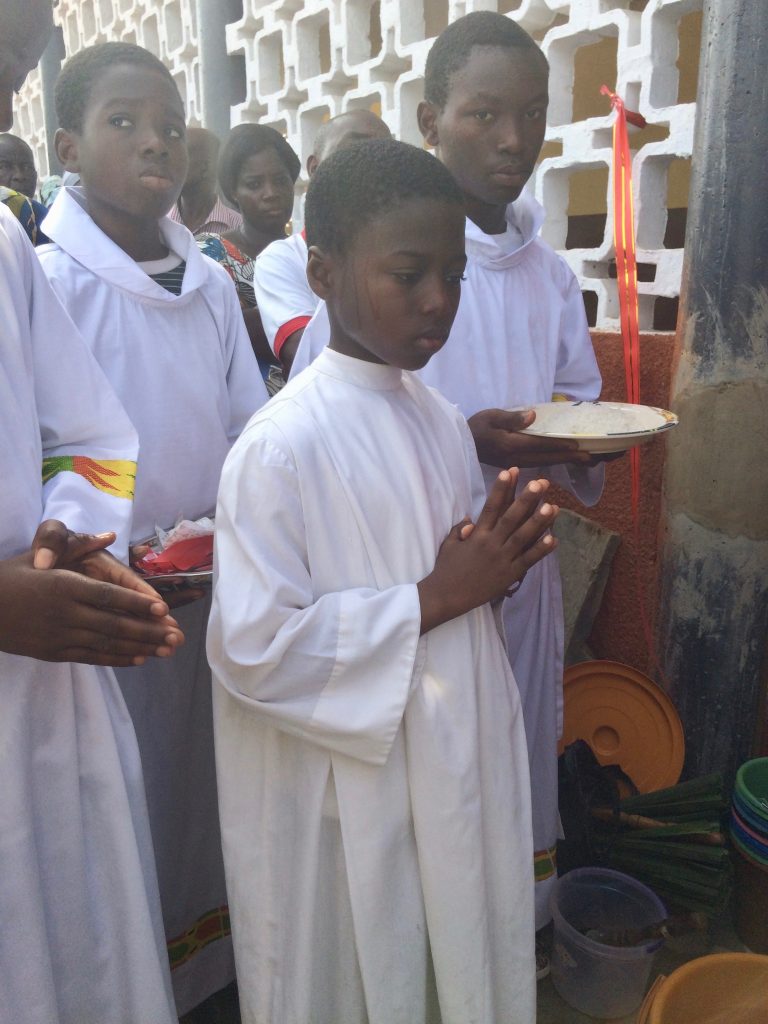
Five days later, when the grand opening finally arrived, a procession led by four altar boys stepped over the church threshold. The first carried incense and the last carried a large wooden cross; the floor was tiled, the fans were spinning, and the room was filled with music.

Gregoire tells the audience to remember that the mentally ill are no different from anyone else—they are people who have an illness that, like any other illness, requires treatment. He exhorts community members to actively support the Oasis d’Amour because it will allow the community to care for the mentally ill with dignity and respect.

Every seat in the church is taken.  As the temperature reaches upwards of 90 degrees, one woman lays down on the cool church floor behind the last row of seats. More than a hundred chairs had been set up outside, nearly all of them were filled. It is here, in a plastic chair, Gregoire sits. He gets to his knees and prays and then returns to his seat. As the services plays out inside, he closes his eyes for a moment of much deserved rest. Tomorrow he will be back on the road looking for new opportunities to serve the “forgotten of the forgotten.”